Welcome

Cooktown Botanic Gardens and Gallop Botanic Reserve
Cooktown Orchid, State emblem of Queensland
Established in 1878 the Gallop Botanic Reserve encompases 62.3 Ha (154 acres) on the edge of Cooktown, Far North Queensland, Australia, and contains the Cooktown Botanic Gardens and walking trails to Finch Bay and Cherry Tree Bay.

Cooktown Botanic Gardens

Sunday, 29 July 2012

The Banks Florilegium is on display in Natures Powerhouse Interpretive and Visitor Information Centre in the Botanic Gardens, until the end of August, not to be missed!  One of the plants on display, collected by Banks and Solander in 1770 whilst on the Endeavour with Captain Cook, was the
Canavalia rosea or Beach Jack Bean, Beach-bean, jackbean , maunaloa, puakauhi, wonderbean, friol de playa, Mackenzie bean, is a pretty vine that trails along the beach sand dunes in the tropics. The thick, fleshy stem can grow to 6m or more in length. The foliage looks rather like a succulent.  It has compound leaves with three rounded, fleshy leaflets which fold up in the middle of the day. The flowers are pea flowers, purplish pink, A feature of the Fabaceae family, the legumes, the nitrogen fixers.
This plant flowers in summer and sporadically afterwards. The  original herbarium specimen collected, dried and pressed by Banks and Solander and now resides in the herbarium at the Natural History Museum in Britain!  Banks had the paintings by the artist on board, Sydney Parkinson, made into copper engravings in the 1700s and paid 10,000 pounds of his own money to do so!
In 1770 Captain Cook was the first Englishman to eat these Beans at Endeavour River. In 1788 Governor Phillip and his crew ate the seeds, but evidently they had tasted raw seeds for they were soon "seized with violent vomiting".
In 1845 Leichhardt recorded in his journal finding a bean which when roasted and ground was found to be a good substitute for coffee.


Canavalia rosea (Leguminosae/Fabaceae)
Line engraving by Gerald Sibelius after Sydney Parkinson (1770) and Frederick Polydore Nodder.
Joseph Banks and his party saw this species at: Bay of Inlets, Australia, Point Lookout, Bustard Bay (22 May - 24 May 1770), Palm Island, Australia (7 June 1770), Endeavour River, Australia (17 June - 4 August 1770)

Thursday, 12 July 2012


Flowering in June in Cooktown Botanic Gardens?

Haemodorum coccineum, Scarlet Bloodroot. Haemodorum; From Greek haima, blood and doron, a gift, a reference to red rootstock of this genus.  coccineum; From Latin, coccineus, scarlet, referring to the red colouring of the flowers.

This plant was collected by Banks and Solander in 1770 and is one of the prints produced from Sydney Parkinson’s drawings from the Endeavour voyage, and one that now belongs to Cooktown. You can see this plant now on display in the Gallery from the Banks Florilegium and Vera Scarth-Johnson's painting, and the living specimen in the Sand Garden. What is really amazing is that this plant would not have existed above ground in June, its dormant period. The specimens in the Botanic Gardens and around Cooktown die back after the wet season, they don’t exist above ground. So how did Sydney Parkinson draw this plant in June 1770? 

Perhaps this was a very late wet season or the seasons were different!  I remember when the wet season started in October, and went til March, now February to April, perhaps our seasons are changing regularly…

This herb of the open woodland or forest is related to the Kangaroo Paw and the grass/strap like leaves arise from an underground rhizome. The dark red flowers appear on a stiff erect stem to 1m high from the rhizome in Oct-Mar. The growth of the plant is dominated by the wet/dry climate of its native habitat. The plant dies back to the rhizome during the winter dry season and reappears during the summer wet season. The fleshy 3-lobed red capsule with red-purple juice appears Nov-Mar-May.

The flowers and roots were/are used by the aboriginals to produce purple-red dye for baskets and bags; reportedly used against snake-bite; dry stems sometimes used for fire-sticks.

Research is being carried out as to its potential as a cut flower because of long life of the vibrant red flowers and the fact they flower during the northern hemisphere’s winter when red flowers are in demand,  a time when red flowers are highly desired on global markets for Christmas, Chinese New Year and Valentines’ Day.  However, the plant is a truly tropical one and doesn’t grow outside of its requirements. Despite being very easy to propagate, growth appears to require soil temperatures in excess of 22ºC at rhizome depth. This unique dormancy mechanism may limit production to tropical environments.

A special thing about Haemodorum species is that they allow only specialised bees to enter and pollinate their closed flowers, thus eliminating other nectar competitors.


Monday, 9 July 2012

June in the Gardens
Amorphophallus species in the Aroid Garden

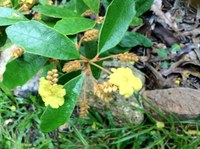
Hibbertia banksii, Collected by Banks & Solander in 1770,
Living specimen of one of the Banks Florilegium prints on display in Natures Powerhouse in the Vera Scarth-Johnson Gallery.  The Banks Florilegium exhibition contains 15 of these prints from the copper engravings made by Joseh Banks in the 1700's from Sydney Parkinson's botanical illustrations of the plants they collected on the Endeavour River in June 1770.

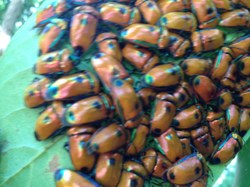
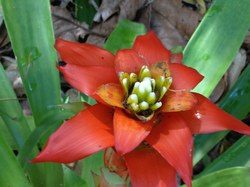
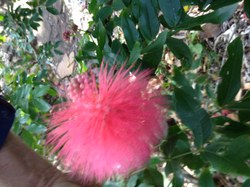
Bugs in the gardenBromeliadCaliandra sp
The amazing bugs (not beatles) are clustered under leaves. They seem to be resting or maybe socializing.
Red flowering Bromeliad Blood Red Tassel Flower (Calliandra haematocephala), has these powder puff flowers all over the shrub.

Cooktown Botanic Gardens

Cooktown Botanic Gardens
Cooktown Botanic Gardens and Gallop Botanic Reserve
Cooktown Orchid, State emblem for Queensland
Established in 1878 the Gallop Botanic Reserve encompases 62.3 Ha (154 acres) on the edge of Cooktown and contains the Cooktown Botanic Gardens and walking trails to Finch Bay and Cherry Tree Bay.

Cooktown Botanic Gardens Today
Guided tours of the garden April-October
Educational and Research Groups and other groups at other times by appointment with
Sandy Lloyd, Curator, 0437 910883.